In industrial automation, electric motors often operate in harsh environments and may be exposed to dust, humidity, water, or chemical agents. In these conditions, the mechanical and electrical protection of equipment is essential to ensure reliability, safety, and long service life. The IP rating standard is the key reference for evaluating the protection level of a motor or a drive, helping designers and system integrators select the most suitable product for specific operating conditions.
INDEX
1. What is IP rating
2. Origin and meaning of the IP protection standard
3. How to read the IP code: structure and interpretation
4. Difference between IP65, IP67, and IP68
5. Protection levels for solids and liquids
6. Industrial applications and critical environments
7. IP rating in industrial electric motors
8. How IP impacts mechanical and electronic design
9. Compliance testing and certifications
10. Choosing the right IP rating for each application
11. Ever Motion Solutions solutions with high IP protection
12. Evolution and importance of IP rating in modern automation
1. What Is IP Rating
IP rating (Ingress Protection) is an international standard defined by IEC 60529 that indicates the degree of protection of an electrical device against the ingress of solid objects and liquids. Each IP code is made up of two digits: the first refers to protection against solids (such as dust or particles), the second against liquids (such as water or industrial oils).
This classification makes it possible to objectively compare the sealing performance of motors, sensors, drives, and electronic equipment, providing a universal reference for engineering design and component selection.
2. Origin and Meaning of the IP Protection Standard
The IP standard was introduced to harmonize the evaluation criteria for electrical devices used in industrial environments. Before its adoption, manufacturers used proprietary definitions (“dustproof”, “water resistant”), which led to ambiguity. IEC 60529 established a clear numerical system recognized worldwide.
Today, the IP code is an integral part of industrial product technical documentation and is required in most machine and automated plant specifications.
3. How to Read the IP Code: Structure and Interpretation
The IP code consists of the letters “IP” followed by two numbers:
- First digit (solids): indicates protection against ingress of foreign objects, from 0 (no protection) to 6 (dust-tight).
- Second digit (liquids): indicates water resistance, from 0 (no protection) to 9K (resistant to high-pressure, high-temperature water jets from any direction).
Example: IP67
- 6 = completely protected against dust.
- 7 = resistant to temporary immersion in water (up to 1 meter for 30 minutes).
4. Difference Between IP65, IP67, and IP68
Among the most common IP codes in industrial automation are:
- IP65: full dust protection and protection against low-pressure water jets from any direction. Ideal for dry or slightly humid industrial environments.
- IP67: adds resistance to temporary immersion. Suitable for outdoor applications or systems exposed to frequent washdowns.
- IP68: provides maximum protection, including prolonged immersion. Used for motors intended for outdoor, marine, or underground installations.
Selecting the right level depends on the operating environment, expected maintenance, and required mechanical and electrical sealing performance.
5. Protection Levels for Solids and Liquids
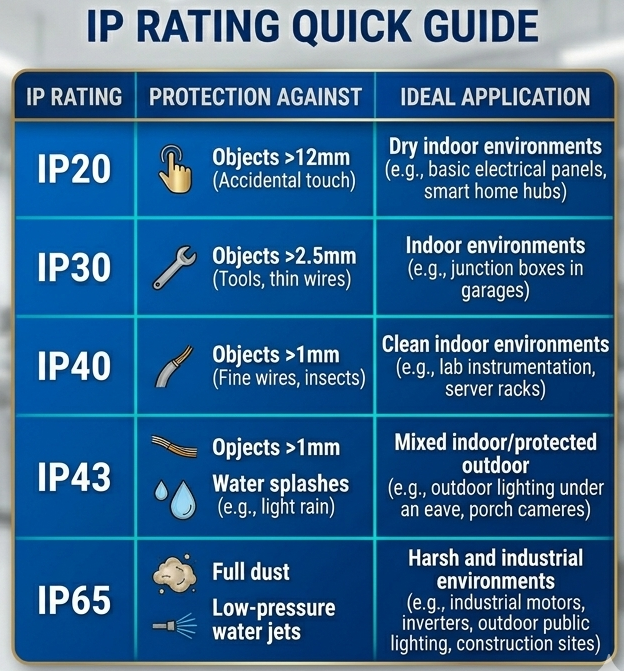
Summary table of protection levels:
| Digit |
Protection against solids |
Digit |
Protection against liquids |
| 0 | No protection | 0 | No protection |
| 1 | Objects > 50 mm | 1 | Vertically falling drops |
| 2 | Objects > 12.5 mm | 2 | Sprays up to 15° |
| 3 | Objects > 2.5 mm | 3 | Sprays up to 60° |
| 4 | Objects > 1 mm | 4 | Splashes from any direction |
| 5 | Dust-protected | 5 | Low-pressure water jets from any direction |
| 6 | Dust-tight | 6 | High-pressure water jets from any direction |
| - | - | 7 | Temporary immersion |
| - | - | 8 | Prolonged immersion |
| - | - | 9K | High-pressure and high-temperature jets |
6. Industrial Applications and Critical Environments
In modern production lines, motors and drives are exposed to variable conditions: fine dust, vapors, coolants, water, humidity, or corrosive substances. Selecting an inadequate protection level can cause ingress and failures. For example:
- Automotive and packaging: often IP65 or IP67 to withstand jets and washdowns.
- Food and pharmaceutical industry: IP69K for high-pressure sanitation.
- Outdoor or marine environments: IP68 to resist immersion and corrosion.
7. IP Rating in Industrial Electric Motors
In electric motors, the IP rating protects critical components such as bearings, windings, and sensors. Proper sealing prevents the ingress of conductive dust or liquids that could cause short circuits or corrosion. Motors with IP67 and IP68 protection are sealed with specific gaskets and resins, while still maintaining adequate thermal dissipation.
Ever Motion Solutions manufactures stepper and brushless motors with different IP protection levels, including waterproof versions, ideal for heavy-duty industrial applications or environments with high humidity.
8. How IP Impacts Mechanical and Electronic Design
A high IP rating requires specific design measures:
- use of O-ring gaskets and silicone sealants
- anti-corrosion materials for the housing and motor shaft
- cable glands and shielded connectors with equivalent IP rating
- controlled ventilation or fully sealed design in high-power motors
The key engineering challenge is balancing protection, thermal dissipation, and manufacturing cost. In high-efficiency motors, sealing must not compromise heat transfer.
9. Compliance Testing and Certifications
Motors and drives are tested in climatic chambers and test tanks to verify compliance with IP standards. Typical tests include:
- misting or controlled-pressure water jets
- partial or full immersion in water
- exposure to talc or silica dust for 8 hours
Passing these tests ensures resistance to real operating conditions and compliance with IEC and CE requirements.
10. Choosing the Right IP Rating for Each Application
To select the correct IP rating, consider:
- operating environment (indoor, outdoor, marine, sanitary)
- motor type (open, ventilated, enclosed)
- cleaning and maintenance procedures
- temperature and presence of chemicals
A conservative approach is recommended: select a protection level slightly higher than nominal conditions to increase service life.
11. Ever Motion Solutions Solutions with High IP Protection
Ever Motion Solutions offers a range of motors and drives with different IP protection levels, designed to withstand the most demanding industrial conditions. Solutions include:
- waterproof stepper motors IP65 and IP67
- AC and DC brushless motors with IP68 protection
- sealed drives and controllers with IP67 connectors
- UL/ATEX certified motors for potentially explosive environments
Each product is engineered to provide maximum reliability, even in the presence of humidity, dust, or contaminants.
12. Evolution and Importance of IP Rating in Modern Automation
With the spread of smart systems and collaborative robotics, demand is growing for compact, sealed, and safe motors. IP rating is no longer just a compliance requirement—it is a true indicator of manufacturing quality.
In the future, advances in materials and sealing technologies will make it possible to achieve even higher protection levels without sacrificing efficiency and performance.