In the world of industrial motion control, precision and speed are not just performance metrics – they are the foundation of production efficiency. Servo motors are key components of this balance, as they convert electrical impulses into controlled mechanical motion with micrometric precision. Their presence is essential in applications where synchronization of movement, torque, and speed must be absolute: robotics, machine tools, packaging, laboratory automation, and advanced medical systems. Understanding how a servo motor works and where it is used means understanding the beating heart of modern mechatronics.
INDEX
1. The Importance of Servo Motors in Industrial Motion Control
2. What Is a Servo Motor and How It Differs from Other Electric Motors
3. Operating Principle and Main Components
4. Types of Servo Motors
5. Closed-Loop Control and Operational Advantages
6. Dynamic Performance and Positioning Accuracy
7. Stepper Motor vs. Servo Motor: Key Differences
8. Brushless Servo Motors: Structure and Specific Advantages
9. Industrial Applications of Servo Motors
10. Integration of Servo Motors with Ever Motion Solutions Drivers
11. Technological Trends in Servo Systems
12. Why Choose Ever Motion Solutions for Servo Applications
1. The Importance of Servo Motors in Industrial Motion Control
The servo motor is one of the most versatile and high-performance technologies for motion control.
In industrial environments, its ability to handle intensive work cycles with high positioning accuracy improves both product quality and process productivity.
In automatic assembly machines, Cartesian robots, and high-speed cutting systems, the servo motor ensures smooth, vibration-free, and perfectly synchronized motion. This reliability makes it a central component in automation architectures based on digital control logic and real-time communication, where every millisecond impacts the system’s overall efficiency.
2. What Is a Servo Motor and How It Differs from Other Electric Motors
A servo motor is an electric motor that integrates a closed-loop control system to regulate position, speed, and torque in real time. Unlike traditional DC motors or stepper motors, a servo motor constantly monitors its operating state through a feedback sensor (encoder or resolver) and automatically corrects any deviation from the target value. This mechanism enables extremely precise control, even under variable load conditions. Servo motors also exhibit a more linear and stable torque-speed curve, making them ideal for applications that require rapid acceleration and deceleration, such as pick & place robots, automatic lathes, or electronic assembly lines.
3. Operating Principle and Main Components
The operating principle of a servo motor is based on the interaction of three fundamental elements:
- 1. The Electric motor (AC, DC, or brushless)
- 2. The encoder which provides the feedback signal.
- 3. The driver or servoamplifier , which regulates current and voltage supplied to the motor.
The central controller compares the
reference value sent from the control system (PLC, CNC, or microcontroller) with the
feedback signal from the encoder. If an error is detected, the driver immediately adjusts the phase current to correct it. This process repeats
hundreds of times per second, allowing the system to maintain constant position even under varying loads. High-end industrial servo systems can manage
resolutions exceeding 20,000 pulses per revolution, achieving positioning accuracy in the micrometer range.
4. Types of Servo Motors
- DC servo motors, are simpler to control and offer good dynamic response, but require periodic maintenance.
- AC servo motorsare more efficient and provide constant torque even at high speeds, maing them widely used in industrial machinery.
- Brushless servo motors now the most common, eliminate brushes and ensure longer operational life, reduced maintenance, and greater energy efficiency.
They can be
synchronous or asynchronous, with
permanent magnet or reluctance rotors. The choice depends on the application: for example, in
collaborative robotics,
synchronous brushless servo motors are preferred for their combination of
lightweight design and high torque.
5. Closed-Loop Control and Operational Advantages
The defining feature of servo motors is their closed-loop control, which enables a level of precision unattainable by open-loop systems. This control method corrects in real time any deviation between the target position and the actual position. Key benefits include:
- Higher energy efficiency
- Reduced mechanical vibration
- Stable torque at high speeds
In a servo system, the driver calculates the necessary corrections within milliseconds, ensuring smooth motion and instant response to direction changes. In fields such as medical and optical automation, this technology achieves micrometric precision essential for high-sensitivity processes.
6. Dynamic Performance and Positioning Accuracy
Servo motor performance is measured by response time, dynamic torque, accuracy, and repeatability. Advanced models reach speeds over 6000 RPM and torques up to 20 Nm in compact configurations. Fast acceleration and deceleration are crucial for applications requiring continuous yet controlled motion, such as dosing systems or high-speed assembly robots. Thanks to Field-Oriented Control (FOC) algorithms and programmable digital drivers, modern servo systems can handle complex trajectories and ensure multi-axis synchronization, resulting in higher productivity and shorter machine cycle times.
7. Stepper motor vs servo motor: Key differences
| Feature | Stepper Motor | Servo Motor |
| Control | Open-loop | Closed-loop |
| Feedback | Not required | Required (encoder) |
| Torque at low speeds | High | Medium |
| Torque at high speeds | Low | High |
| Energy Efficiency | Medium | High |
| Position accuracy | Limited | Micrometric |
| System cost | Lower | Higher |
The
stepper motor can operate in
open loop, moving in discrete increments (steps) without verifying its actual position. It is ideal for
simple, low-cost applications, but suffers from torque loss at high speed and potential step loss. The
servo motor, by contrast, works in
closed loop, continuously receiving position feedback and maintaining torque even at high speeds. In practice, stepper motors suit
light automation and 3D printing, where extreme precision is not required, while
servo motors are essential in
assembly lines, robotics, and CNC systems, where
speed, precision, and repeatability are critical. If your goal is low cost for simple tasks, a stepper motor is suitable; if you need
high performance with rapid, precise motion, a servo motor is the clear choice.
8. Brushless Servo Motors: Structure and Specific Advantages
Brushless servo motors represent the most advanced solution in modern automation. Their permanent magnet rotor provides a stable magnetic field and high torque, while the multi-phase stator ensures optimal thermal management. The absence of brushes eliminates friction and electrical noise, improving durability and quietness. High-resolution absolute or incremental encoders allow precise motion monitoring. Brushless servo motors can also be built with stainless steel housings, ensuring excellent performance and hygiene compliance in food processing and pharmaceutical automation systems, where cleanliness and reliability are critical.
9. Industrial Applications of Servo Motors
Servo motors are used in a wide range of industrial applications, including:
- Articulated robots, for joint movement with millimetric precision
- CNC machines, to control axis rotation and ensure perfect surface finishes
- Packaging systems, to synchronize conveyors and filling heads, reducing material waste.
- Optical inpsection machines and medical instruments , for precise control
- Automated measuring and intralogistics systems, and textile machinery
In all these cases, the servo motor’s ability to maintain constant torque and immediate response makes it a cornerstone of production efficiency.
10. Integration of Servo Motors with Ever Motion Solutions Drivers
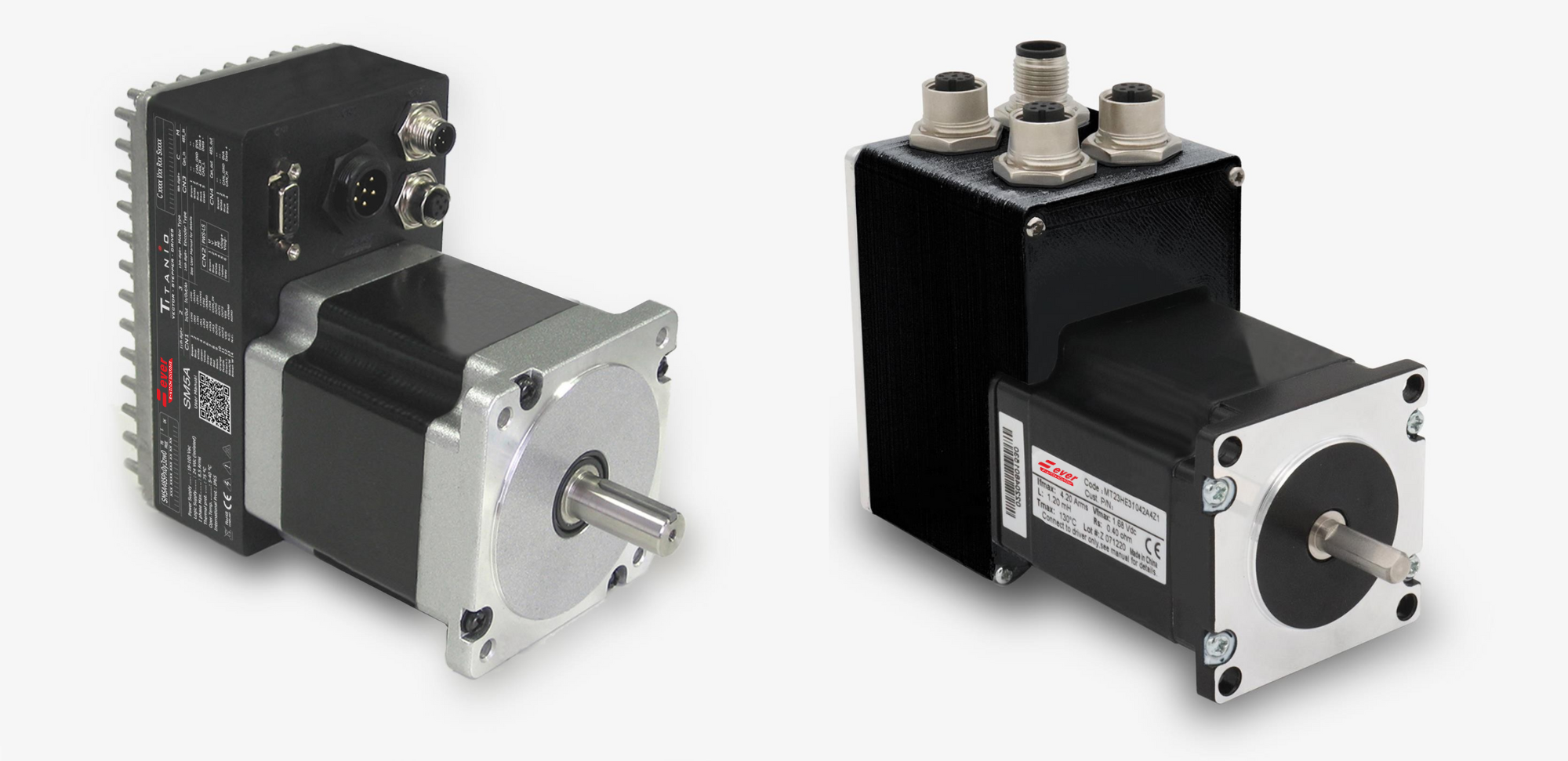
Ever Motion Solutions designs and manufactures in Italy a range of brushless servo motor drivers developed to maximize performance and simplify integration. The Platino and Vanadio series – also available in open-frame versions – include programmable drivers with fieldbus communication, compatible with CANopen, Modbus RTU, EtherCAT, Profinet, EtherNet/IP, Modbus TCP/IP, and Powerlink.
These solutions enable advanced torque, speed, and position control, as well as real-time monitoring and predictive diagnostics. Integration with Ever Motion servo motors ensures optimal performance and simplified management, even in multi-axis or complex systems.
11. Technological Trends in Servo Systems
Servo systems are evolving in line with the global shift toward smart automation. Next-generation servo motors integrate IoT sensors for operational data collection and predictive maintenance algorithms that detect failures or performance drops before they occur. Intelligent drivers automatically adjust control parameters based on load and temperature, optimizing energy efficiency. The growing adoption of fieldbus communication and decentralized architectures allows faster, synchronized communication between devices, improving precision and reducing process latency.
12. Why Choose Ever Motion Solutions for Servo Applications
With nearly 50 years of experience in motion control, Ever Motion Solutions is a leading reference for reliable, high-performance, and customizable servo systems. The company offers a complete range of brushless servo motors, digital drivers, and integrated motor-drive solutions, all designed and manufactured in Italy. Every solution is developed through close collaboration with customers, ensuring seamless integration with existing systems and application-specific performance. A strong engineering approach and continuous technical support make Ever Motion Solutions a strategic partner for developing high-performance industrial machines and automation systems.